Tuesday, August 16, 2011

How to Race Even Faster

There are several ways to become faster in racing.
  • You could use performance enhancing drugs. But, with the legality, ethics, and cost involved, this is not the best decision. Plus, you could get banned from sport and shunned by your friends/ colleagues. Avoid this option.
  • You could buy better equipment. A lighter bike, fancy wheels, better clothes, will indeed increase your speed (to some extent). This may be cost limited and once you start down this path, you are destined to continue it until someone throws an intervention.
  • You could lose weight. And by weight, I mean fat (and sometimes muscle). A lighter you has less to haul around. Your same muscles have to do less work to cover the same distance. You go faster. But, this system takes time, patience, and commitment. Happily, it will probably save you money in reduced grocery bills and less visits to the doctors.
  • You could train better. Doing intervals, hill repeats, and speed work will train you body to operate at faster speeds. This is the most painful option. But with high risk comes high reward. Your muscles will provide themselves with the necessary adaptations allowing you to move faster on race day.
  • You could hire a coach, who can help analyze your training and technique. Coach can help fix flaws in your methodology and technique and provide you with accountability.
All of these are valid methods of improving your race day performance. Except for the first one, should you cherish going faster, you could do them all concurrently. But, once race day arrives, then what?

Coming off my most recent success at the Summer Sizzler, I learned one amazing, magical tip to help you go even faster. It requires no additional work from you. In fact, it actually requires less work from you than you would normally expend before a race. You won't find this tip in any book, magazine, or elsewhere on the planet. But, it worked for me and I, in my generous state of being, am willing to share it with you, free of charge.

Bit of Background
So, before I tell you how to get faster with this one magical piece of advice, the one that may change your race day forever, I must tell you how I narrowed it down to this 1, purely genius aspect of race preparation. I, like many before me, are quite methodical in getting ready for a race. (Hint, that was not the tip.) I get things ready the night before. I have the bags packed. I have the car ready. I have the bike(s) on the rack. I have water bottles in the fridge. I have the espresso machine prepped. Everything is exactly where it needs to be. That way, when I do to sleep, I have nothing to think about. I only have the race and sleep. All other worries have already been addressed.

I choose, on purpose, races that are within the 2-hour driving distance limit. I am too poor to constantly be spending the night in hotels. I am not popular enough to have many friends in other towns. I am too lazy to drive further or make new friends. The best reason I don't travel longer than 2 hours- I don't need to. There are lots of good races in the area within that radius, assuming that I am racing between June and mid-September.

This makes my morning routine, well, a routine. I change nothing. This is mostly because I am uncreative and boring. So, when something unexpected happens, I can look back and figure out what was different about the pre-race stuff. This is a foundation of scientific inquiry. Keep everything the same save one. If the results show improvement, you have a winner. If there is something substantial, this strongly correlates to causation. On the morning of the Summer Sizzler, there was something distinct. Something was wrong. The routine was off in one clear, distinct manner. And, as a result, I had a great performance. I am a better man for this event and I have the race results to prove it.

What Did NOT Happen
Research says that tapering and relaxing on the days prior to a race will yield strong results. As your body recovers from hard efforts, your muscles repair any damage, glycogen returns to the muscle cells, and your body adapts to the stress coming back even stronger. What did I do? I upped my training and worked out hard the days before the race in all 3 disciplines. Scratch that.

Caffeine is reported to have an ergonomic effect. The current line of thinking is that caffeine enhances fat burning capabilities while simultaneously blocking pain receptors. There is an upper limit to caffeine consumption and your body develops a resistance to caffeination. But, for this race, I was under caffeinated as compared to the norm. No research has yet proven (to the best of my knowledge) that a lack of caffeine is better. That idea is out.

Other Research
I know, get on with it, what actually makes you race even faster? Patience. I will get there. But, I want to make it abundantly clear that this is the reason, beyond any doubt, that caused my great race. And, I am certain, it will work for you.

Maslow- Most important on bottom
If you want to win, you will work at winning to the best of your ability. This can oft be cited as a 'need to win.' According to Maslow's Hierarchy of Needs, certain needs trump others in a list of priority. For example, when you are hungry (such as starving), the need to be liked by your friends seems unimportant. Hunger trumps friendship. But, it you are hungry and drowning, the need for air wins. Breathing trumps hunger. Winning is on the list found at the top in the self-actualization area. Winning gets trumped by many other things, everything below it on the pyramid.

So, here I am at a sprint triathlon, and there is one aspect of the race that is different. This was the single, most important reason I was able to push the envelope and achieve a level never before seen by the Banter in a race. Pure Zen as I reflect back.

The Secret Happens Just Before the Race
The swim start was a run-from-the-shore time trial start. Here's where life got different and the big event was about to occur. We lined up on the beach and they sent us off in groups of three. But, in doing so, I didn't get a chance to warm up (Hint, the advise is not 'don't warm up'). This shouldn't matter anyway as I never actually warm up in the traditional sense of the word. I do tend to get in the water before the start. I get in the water mostly because they force us to start there. Otherwise, I'd probably stand on shore until the last possible moment then work my way to the front right before the gun.

Starting from the water has it's advantages. First, you get a chance to get used to the temperature. Now, if you're in a wetsuit, temperature acclimation is probably moot in all but the coldest of conditions. However, if you are going in your skivvies, knowing the temperature of the water is beneficial. I have a gasp reflex in cold water. Upon submerging my chest and head in chilly water, breathing becomes difficult. Picture a fish out of water, that's me in cold water. Unlike the fish, I get better after a brief period of time. The water temperature for this race had to be in the 70ºs, negating my reflex arc.

Something else happens when you enter warm water. You desire to, um, heed the call of the wild takes over. Triathletes are notorious for marking the swimming territory like a hound at a fire hydrant (some can even be caught lifting their legs). The lake, or in this case river, masks the pungent liquid in volume. Stop wrinkling your nose. This is a fact of life and a fact of racing. Get over it. When you think about it logically, the volume of urea produced by all of the athletes in a given race pales in comparison to the volume of water. There are more fish and other animals in the exact same area producing a higher amount of more concentrated waste than the racers could ever hope to supply. Further, many of the aquatic flora thrive on the gifts you have just given them (as evidenced by the amount of sea weed present in this specific race). So, you make think this habit is gross, when in reality, it is all in your mind.

Anecdotal evidence suggests that seconds before the race is the most satisfying time to release. You start the race with less pressure, at least in the bladder sense of the word. You also start a few ounces lighter. Yes, I am getting there. I know that this post is supposed to be about racing faster and somehow it's turned into a gross lecture on the benefits of leaving human waste for others to swim through.

Racing Under Pressure
In all honesty, I did not participate in this defiling of the Niagara River. We started from shore and I have enough humility not to pee myself on a beach in front of a few hundred racers and spectators. I prefer to pee myself in the relative anonymity of hiding in the water. From the moment I entered the water, I was in race mode. Urination requires relaxation. After the initial jog, I was racing hard and the furthest thing from my mind was relaxing. This is not to say that I didn't want to go. Just the opposite... before the swim start, I really wanted to go. Any practical joker can tell you that entering luke warm water, submerging your head and hands into what felt like a bath, served only to intensify the desire. It was hard to think of much else. Stroke, breath, God I have to pee. Stroke, breath, please let me go pee. Etcetera.

Once the swim was done, I frantically looked for a place to go. We jogged up the beach to transition. There were some scattered trees but the route took us next to a park. Several kids and moms were playing on the swings. Call it performance anxiety or call it a refusal to expose myself to women and children, I just couldn't do it.

While biking, I was hammering at the pedals. All the while, I was thinking, "Hmm, that tree looks like a good spot." Or, "I wonder how much time I'll lose if I duck in there." At the same time, I was passing people left and right. Alright, I was passing mostly left because passing on the right is an illegal pass according to USAT rules. I was stuck between 2 of Maslow's needs: winning versus peeing and peeing was winning. Then, a thought occurred to me. I thought, they have bathrooms at the bike area! This intensified my spirit. No longer was winning important to me. I had to get back to transition as quickly as possible. I hammered on.

Upon arriving to transition, I did a flying dismount and frantically searched for a port-a-potty. I couldn't find it. I was hurting and gasping for air from my bike effort. I donned my shoes, ran to the nearest volunteer and in broken breaths asked, "Which...<breath>...way...<breath>..." The volunteer cut me off.  "to... the... bathroom?" never escaped my lips. The man seemed to know what I was asking and pointed to the east. I ran hard. Yet, I did not see it. He definitely said it was this direction. About a quarter mile later, there was another volunteer pointing. I followed. I was on autopilot now. They could have steered me into an incinerator for all I cared. Winning was being trumped by bladder pressure. More volunteers. More pointing. Some actually wanted to give me water. I was trying to get rid of water. "No thanks," I gasped and grimaced.

As the pressure intensified, so did my heart rate. Here's my HR profile for the run portion of the race.
As you can see, by the end, I really had to go. My only thoughts were on the bathroom. I surged. I sprinted into the finish line. And I finally made it! I put an end to both the race and my misery.

Conventional wisdom says to take care of business before the race starts. But, based on the evidence and success at the Summer Sizzler, conventional wisdom has just been disproven. Do all the things I suggested at the beginning of this post (minus the drugs). But, come race day, do not relieve yourself. Let Maslow take over and I will personally guarantee success. You won't thank me for it. You'll probably curse me should you even attempt it. Not that I care. I am only interested in your success. Good luck and race under pressure. You will go faster than you ever thought possible.

Sunday, August 14, 2011

Race Review and Results- Summer Sizzler

Pre-Race
Since I had incepted the Short Season, I have been motivated to work on my speed skills in all 3 disciplines. I have not, so far, disappointed myself in training. Monday I worked out hard on the bike and run. Tuesday was a had session in all 3. Wednesday was a day off (for some reason that I cannot even remember why). Thursday was a long run, hard bike and hard swim. Friday was mile repeats on the bike, half-mile repeats on the run, and 50s in the pool on a pace that I haven't hit in over a year. In a nutshell, I was tuckered.

When we originally signed up for the Summer Sizzler, gun time was a nice and cushy 8:00 am. 9:00 would have been better, but for some reason, people don't like to put on races that 'late' in the day. Due to uncontrolled circumstances, they were forced to move the start time up to 7:00 am. Whereas I am a procrastinator, the Wife is not, we were stuck leaving earlier than my sleep settings would have preferred. Since we had not yet picked up our race gear, that meant we had to leave the house by 4:45 am to get to the race at a decent hour.

I love race volunteers. They do their best with the happiest of attitudes. Sometimes, however, they don't do it quickly. We got on site at 6:20, giving us a full 25 minutes to pick up our packet, set up,  and get out before they close transition. Under normal circumstances, this would not have been an issue. However, it was obvious that, as we waited in line, getting out of transition by the allotted time was going to be next to impossible. The line had moved roughly 3 feet in 10 minutes and we had many feet to go. We actually walked into transition as they were closing it. I looked back at the line and there were still people picking up their race numbers. Well, we tried to get there early (by my standards anyway).

Notice that I have been using the second person, plural pronoun 'we'. That's right, the Wife was making here 2011 triathlon debut and return to the sport in at least 2 years! It may have been 3 since she last SBR'd and, to be honest, I was a little nervous. I love going to races with the Wife. It's like bonding time for me. Even though we rarely race at the same time, I always feel like we are racing together. I wanted this to go well for her because I like it when things go well for her. I also want her to continue doing tri's. A bad experience may be anti-motivational and she might continue to just be a runner again.

So far, it was not going well. She hates mornings and the loss of an hour on the start was not a positive move.  She was a bit cold. She doesn't enjoy the pressure of hurrying through transition. I said the only thing I could think of to try and ease her suffering. That's what husbands do, right? They see a damsel in distress and they try to be chivalrous. Boys are problem solvers especially when it's a girl having a problem. Our desire to help grows substantially when the damsel is a hot chick to whom you happen to be married. I had to do something. Think, Banter, think. How can I improve this situation? Then, I offered her the only thing I had to offer which may help out. I said, "Would you like to wear my wetsuit?" She did and I had the feeling that things were about to change for her.

The Swim
The swim is in the Niagara River. As in the Niagara Falls. I am sure all of you have heard of this amazing spectacle of mother nature. Here's some things you may not have known:

Swim here?
The Niagara River connects Lake Erie to Lake Ontario. The problem is that Lake Erie is more than 300 feet above Lake Ontario. So, as the water drains from one Great Lake to another, it picks up speed on its way down. The water speed can range from 25-40 mph. More than 6 million cubic feet of water flow over the Falls every minute. Imagine swimming in that. (You can read more about NF here. )

Don't fret, because most of that height drop, water volume and water speed happens at Niagara Falls proper. We were several miles upstream where the water speed and volume was moot. In fact, the water was so calm and warm, the sea weeds were ripe and ready to harvest. The weeds were a problem for racers in the past, so the RD promised that they had sent in a clipper and trimmed the race course. There should have been no weeds in the way this year.

The race was not a mass swim start. They opted, instead, to make it a 3-at-a-time-trial start. For those of you who aren't sure what this means, I'll explain. They lined us up in (nearly) race number. I believe we were on our honor system here since they couldn't see our numbers. This is because many people were in wetsuits (not me, as I gave mine away). Other people showed up to the race late and did not have the opportunity to get body marked (ok, this may have been me). A volunteer put racers side-by-side-by-side in groups of 3. Two more volunteers held out their hands blocking the path to the water. Someone yelled 'Go' (not sure who) and the 2 volunteers raised their arms dramatically. The next group of 3 stepped up. Repeat. Soon it was our turn. We took off. And by took off, I mean that I sort of jogged, the guy in the middle walked, and the guy on the other end sprinted. I caught sprinter guy very quickly as the bottom of the Niagara River was 4 inches deep in mud (fun to squish between toes) and dotted with the occasional rock. The combination of mud, stones, and thigh deep water make sprinting counter-productive.

I'm not sure what their weed harvester looks like, but it didn't cut very deep. Looking at the tops of the stalks, they had obviously been cut. Either the cutter only makes it about 18 inches below the surface or the weeds are capable of rapid growth. The ~400 yard swim was far from weed free. And, with a time trial start, the swim was far from people free. In a mass or wave start, I can surge for the first couple of minutes and pretty much have the swim open to me and one or two other blokes of similar speeds. Not this time. There were lines of people of various abilities sifting their way through the floating jungle. It provided an extra challenge but was not a bad experience (except for that weed or 3 that made it into my mouth).

I came out of water in 22nd place and roughly a minute and a half behind the leader. I'm pretty sure that I lost some time running from the beach to transition. It was uphill through sand, grass, and finally pavement. I don't normally attack this sort of thing and there were several people who gave the roughly 250 yard dash some hard effort. I had to time to make up on the bike.

The Bike
I thought I would have a fast transition. Without a wetsuit, I had nothing to struggle over my calves. But, I swam topless. USAT 'strongly recommends' that we wear shirts on the bike and run. Fine. I'll conform. Putting a tight, triathlon jersey over a wet body is not the most efficient experience. The shirt will roll and refuse to become smooth. My guess is that I lost at least 30 seconds to the shirt and the entire transition cost me about 45 seconds on the leader. Time to haul.

Out onto the course, it was a brief out and back. Most sprint triathlons are right around 13 miles. The advertised distance of the race was 17 km, or 10.6 miles. Because of the fact that I had just finished recovering from IMLP... Because of the fact that I had trained hard all week... Because of the fact that I did not get much sleep... Because of the fact that I have been slow on the bike all season long (as compared to a year ago)... Because of the fact that I was under caffeinated... Because of the fast that I am, for the most part, a big pansy... I was not expecting greatness.

The ride was relatively flat. And by 'relatively', I mean super. I flew. This was easily the fastest bike ride of my triathlon career. I felt amazing. Even when my heart rate was in upper zone 4 (the threshold for racing), my legs seemed to want more. I passed scores of people. This is one of the drawbacks of the time trial swim start. I had no idea how I was doing in the race. Therefore, I kept hammering. Sometimes it's good to be wrong.

I also felt a bit guilty. No, not because I was doing well in the race, but because I did not have any body markings. Everyone else had a calf marked with 'F1' meaning Formula 1 (a double triathlon in which I was not competing) or 'S' meaning Sprint (in which I was competing). I was able to pick out who I was racing (the 'S' people) and who I was not racing (the 'F1' people). The F1 people started before the S people and I passed a bunch. I regret that those same people did not knew if I was in their race.

In this race, I averaged 21.7 mph. I think that number is a bit skewed. Even though the race was supposed to be 10.6, my gps registered just over 11.3 miles and clocked me at 23 mph. Looking at the paces of some of the guys I know to be awesome cyclists (whom regularly beat me in races and I check out their efforts to see what it takes to be good), their paces were slow compared with their history. Still, my bike leg was good enough for 6th place and I had moved up in the pack.

The Run
There was a guy about 15 seconds in front of me at the end of the bike leg. I pulled my feet out of my shoes, straddled the bike, and did a flying dismount. I actually beat this guy into transition. I found my slot, slid on both socks and shoes, and grabbed my race belt. I learned that I don't need to stand there and put on my race number. I can take care of that while I am running. I took off.

To be truthful, I knew I was biking hard and fast. This can be a problem. A person has only so much in the tank. If you give it away on the bike, you have less to spend on the run. I know this. However, that concept was lost on this race. This is a short race and my gas tank was big enough to handle the load. So, I went for it.

The course was rather flat. There were no real hills to slow me down or speed me up. I decided to ignore my heart rate and just run. Hard. At the beginning of the season, I wanted to run 7:30 minutes per mile in open runs. My fastest pace in a triathlon was 7:05. That was before the knee injury. I was running hard and my legs were tired. I had no idea how much speed that would yield. So, when the watch auto-beeped at the 1-mile mark, I looked down and saw 6:37.

What? I am not that fast. Maybe there were some hills after all. Surely the second mile will be uphill and my pace would dramatically slowed. See the amazing hill, right there at mile 1.6. It climbed about 11 total feet. Ouch. (In case you missed the sarcasm, Ironman Lake Placid has over 1,100 feet of ascension on the run course alone. Eleven feet, in comparison, may not even exist.) The second mile beeped in at.. well, nothing. The run did not make it a full 2 miles. It was advertised as a 3 km, or 1.9 mile run. Plus, I didn't stop my watch when I hit the finish. Normally, I would remember to stop it several minutes later, but I think I got this one within about 10 seconds.  Even with the delay, I was at a 6:52 pace. I could not have been more surprised. Looking at the overall results, they had me at a 6:19 pace. My overall run leg was good enough for 8th place.

Post-Race
When I checked the results, I was in 4th. Not age group. Overall. At just over 52 minutes total, this is the highest I have ever placed in a race of any kind. So, I did what any other person in this situation would do. I start looking at the 3rd place guy, just to see... Well, he was a good 2 minutes ahead of me and I had the fastest speeds of my career. I gave it my all. So, I decided to check 5th place. Eight seconds. That's by how much I beat him. I've seen this guy around at several races and he beats me more often than not. He told me that he had the best race of his life too. Maybe the Summer Sizzler does that to people, gives them their best races.

Like a good husband (I bet you forgot about the Wife), I went back out on to the course to find her and watch her finish. There's nothing sexier than a hot chick, in lycra, finishing a race. I hung out in a shady area with about a quarter mile left. At last, the hottie arrived. I clapped, I cheered, I gave a hoot and hollar. How did she respond? She yelled at me for messing up her bike computer.  While running, she actually took the energy to yell at me, and continued running.

It's true that earlier this week, I gave her a new computer. The new one does all the stuff her old one did, except this one has a cadence sensor. Like all men handing out gifts and doing favors for their loved ones, I was trying to do good. I also thought that I would have the opportunity to bike with her and go over the basic functionality. Her work week was not that great and the tutorial never happened. Since we didn't get to the race all that efficiently, we both forgot about the new hardware mounted to her frame. She remembered it when it was 1. Not zeroed out and she couldn't figure out how to reset during mid race. 2. While trying to reset, she dislodged it from the mount. 3. She stopped biking, turned around, and spent an eternity looking in the grass for the (her words), "<Bleeping>, no good <bleeping>, device." I let her rant for a while. I deserved what I got and it's normally over once the rant is finished.

I checked her time. She was at 1:08 and in 114th place. I imagine that she lost between 3-5 minutes in her computer search. When I asked her if she enjoyed herself at the race. She lowered her eyebrows (and I, therefore, got nervous) and said, 'Yes.' (Sigh of relief). Then, in an effort to sate her further, we went shopping at the outlet mall. I called it a 'recovery walk'. It was a good day for us both.

Wednesday, August 10, 2011

Post IM Recovery- Evidence

Pick up a copy of Joe Friel's 'Going Long, 2nd edition'. I'm a big fan of this book. When I first got it, I read it cover-to-cover. Now, I use it as a reference. Turn to page 327. Find the 2nd to last paragraph. It explicitly states, 'Do no running for at least four days after a half-Ironman-distance race and twelve days after an Iroman-distance race.'

Naturally, my first run after Ironman Lake Placid was 8 days post-race. It did not go well, just as Friel predicted. I was clearly not recovered from the big race. I had been doing active recovery swims and bike rides. But, running is the most obvious place to measure your recovery.

My first run was a 3.5 mile jaunt on a course with which my legs were very familiar.

Am I Recovered?- Take 1
I, like most of you, have a mental block on running distances. Currently, my lowest run distance is sitting on this route and the Ego tells me that I cannot go shorter than this run unless I am injured, running after a super long ride, or out for a joy run with the Wife. Since none of these scenarios applied, I was stuck with the full 3.5. Again, this is day 8 post IM.

I was supposed to keep my heart rate in zone 1 or low zone 2. The border of these zones for me is 163. As you can see, I failed miserably. My failure wasn't the only miserable aspect of this run. I didn't need HR or pace to tell me this sucked. I felt horrible. On even the smallest inclines, my legs burned and my HR soared. My average HR was in the middle of zone 2. My max HR was mid zone 4 (normally reserved for racing and speed work). The only reason my 2nd mile was so 'fast' was the inclusion of a half-mile hill (see hill profile above). This was my only workout of the day and the effort left me comatose. That was Monday morning (a good time to be a zombie). Definitely not recovered.

Am I Recovered?- Take 2
I decided that I would not go again for a couple of days. I did swim and bike easily during the next 2 days. Now, Thursday morning arrives. This was day 11 post IM (still 1 day under the Friel recommendation). I talked myself into going for a run (which was a frustrating back-and-forth conversation which I almost lost). Despite my relative suckiness at the discipline, I actually enjoy running. I feel free when I'm out amongst the elements. Here's the data:
This is the exact same course, at the same time of day, in similar weather conditions. Notice how my average heart rate is significantly lower (zone 1 as opposed to upper zone 2). My max HR is a good 16 beats slower. My overall pace is faster despite the fact that my first mile is slower and the downhill mile is roughly the same. I felt a little better on this run, but still not great. My chest did not feel open and I was definitely ready to stop by the end of the run. Not recovered, but getting better.

I continued to swim and bike. But, now the weekend has arrived. One of my favorite qualities of recovery post-IM is the inclusion of the Wife in my workouts. She went for a bike ride with me. She took me on a trail run. Since she does not carry the Male-Ego gene and does not feel the need to challenge each workout, we went slowly. It was absolutely perfect.

Am I Recovered?- Take 3
Since I declared that I was adding a short season to my schedule, I started short-season training on Monday. This is now 15 days post Lake Placid (3 days after the window of running opportunity). Monday morning, I went for an 18 mile ride, which included 5 x 1 minute zone 4 hill efforts followed by 1 minute easy. Then, I went for a 4.5 fartleck brick run (1 mile warm up then 5x[ 0.25 mile hard, 0.25 mile easy], cool down) immediately following the ride. My legs felt the effort.

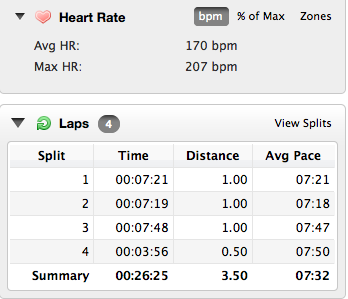
On Tuesday, 16 days after the big deal, it rained. I was tempted to ride outside in the drink but the lightening and thunder forced me to set up the trainer (I am still sulking about this fact. I hate the trainer!). After a 10 minute warm up, while watching a bad movie, I did 5x 1:00 all out with 4 minute recoveries. Then, I set out for a 3.5 mile run, on the same course as I showed you before. When you see this data, keep the situation in mind. The other runs were solo workouts of the day. The previous days were light, easy type efforts. This workout was the second half of a brick. The first half included hard efforts. The day before included hard efforts and my legs were pre-fatigued going into the bike ride. Here's the data:
A couple of points of interest. Notice how the pace of the run is significantly faster. Again, this is on the exact same course as the other 2 runs. The heart rate numbers show a data anomaly, which I assume was an equipment malfunction. An extrapolation of my heart rate zones yields a max heart rate of 202, therefore 207 should be statistically impossible. This heart rate problem occurred around the 21:00 mark, which I can assure you that I was feeling fine, and may have been induced by the rain. I may have been struck by lightening but I cannot seem to remember (the Wife did notice a 'burnt' scent around the house when she got home but we did not find the source). It also goes to show that you cannot 100% rely on HR data.
I am assuming that, if you ignore the 2 obvious HR spikes (again, I am certain from equipment issues, lousy Garmin), my average HR drops a few points. Even with the anomaly, my average HR is only 1 beat off of the 8-day run. But, my average pace is more than a minute faster. Ready or not, here I come.

Conclusions
-Recovery is not complicated. Simply don't do stuff for a while.
-Trying to force workouts before your body has recovered will not be fruitful.
-Heart rate is not always reliable. Include rate of perceived exertion (RPE) in recovery.
-Workout with your Wife
-The indoor trainer should be avoided at all costs.

Tuesday, August 9, 2011

Brief History of Swag

As I re-read over and over again due to my OCD reflected on my recent swag post, I started to ponder how and when the idea of swag came about. Therefore, I decided to do some research on the history of swag. I wanted to get down to the basics, the nitty gritty on the evolution of this thing we now call swag. I found nothing. Here's a brief overview of what I did not find:

The First Evidence of Swag
The earliest indication of swag can be found in the Lascaux Cave Paintings in the south of France. Archaeologists, in a never ending battle to discover the roots of human existence, have dated these paintings back to more than 30,000 years ago (an amount of time equal to my IM run split). Originally, scientists interpreted these paintings as a Day in the Life (which the Beatles later re-made into a hit song). A more careful look at the photo will reveal more intriguing clues. Clearly, this was a deer shooting contest. The event was sponsored by Gander Mountain, back in the early days of the company's inception. Those who registered early got a fancy new bow string, such as the guy in the top of the painting. Since Gander Mountain did not expect a large number of competitors, the late comers did not receive any swag. The bow string guy seems to be the only one in the picture not stressed, sitting back and enjoying the moment. The others are frantically trying to figure out how to launch their arrows without string. They are trying different yoga poses (this was after yoga was invented) in an effort to maximize their bows' efficiency. Scientists are still unsure why one deer has arrows sticking out of his chest. To their best guess, they think the bow string guy shot this deer as it is clear he is out of arrows and that deer was in front. Either that, or they guy immediately in front of that deer has a pretty good throwing arm. The debate rages on.

Swag, the Later Years
The literature is really quite scant on swag details, unless you know where to look. Jump ahead in history a good 28,000 years to Ancient Egypt. During this time, Queen Cleopatra ruled the empire. Cleo had 4 different husbands during her life and was reputed to be constantly bored. She held numerous contests in an effort to keep herself amused. But, since she was also in the habit of killing off some of the losers, many of the common folk were not motivated to join in the competitions. Cleo noticed that participant enrollment in her Temple Building and Pyramid Building contests were at an all time low. She reached rock bottom when she held a Sphinx Building contest and just one guy registered. And, he built his structure without a nose. Cleo called together a group of advisers to discuss how to increase contestant registration. They suggested that she start handing out gifts, royal mugs and wine goblets, to those who signed up (as evidenced in the pyramid carving). The idea worked! Sadly, not all of Cleo's contests were great ideas. Her worse idea, Cutest Snake contest in which she was the judge.

Current State of Swag
The Urban Dictionary (the only resource I will cite today, proving the validity of this post) has several definitions of swag. As an acronym, it means 'scientific wild ass guess'. Or, it means 'sista with a gun' for some reason. Also, it can mean 'stuff we all get'. If you are going to a conference, this last definition may actually apply. But, if you sign up for an athletic event, spectators don't get swag, thus negating the UD definition. Spectators may get door prizes instead of swag. Door prizes are unexpected free stuff. Swag is unexpected free stuff. Obviously, they are not the same thing.

In today's economy, swag has been reduced to advertisements for semi-entertaining blogs, coupons for online shopping, travel-sized samples, and, in the rare occasion, pictures of the race director while he was on his last vacation (taken by non other than Brightroom photography).

So there you have it. By now, hopefully, you understand the meaning, history, and importance of swag in the context of the modern triathlon.